
Your Home Doesn't Need to Look Like Pinterest to Be Organized
If you've ever looked at a perfectly organized pantry on Pinterest or Instagram and thought, “There is no way I could keep my house looking like that,” I want you to know something:
Your home doesn't need to look like Pinterest to be organized.
In fact, some of the most beautiful organizing systems I've seen aren't necessarily the prettiest ones. They're the ones that actually work.
To me, organization is much less about how a space looks and much more about how it functions.
So, what does it mean to be organized?
At its simplest, being organized means having a system where everything you own has a place to “live.”
You know where to find something when you need it, and, just as importantly, you know where to put it when you're finished using it.
That's it.
It doesn't mean every item needs to be in a matching basket. It doesn't mean your pantry needs to look like a showroom. And it definitely doesn't mean your home needs to stay perfectly tidy every minute of the day.
A good organizing system should make your life easier, not give you another job to keep up with.
Your organizing system needs to work for YOU
One of the biggest things I consider when organizing a client's home is how they actually live.
Where do you naturally drop your keys when you walk in the door?
Where do you look for batteries?
Where does the family keep sunscreen?
Where do the kids put their shoes?
Where do you put something when you're finished with it?
The answers to those questions help create systems that are realistic and sustainable.
Sometimes the best place for something isn't the place that looks the prettiest. It's the place where you're most likely to actually put it away.
And that's okay!
Labels aren't just pretty - they're helpful
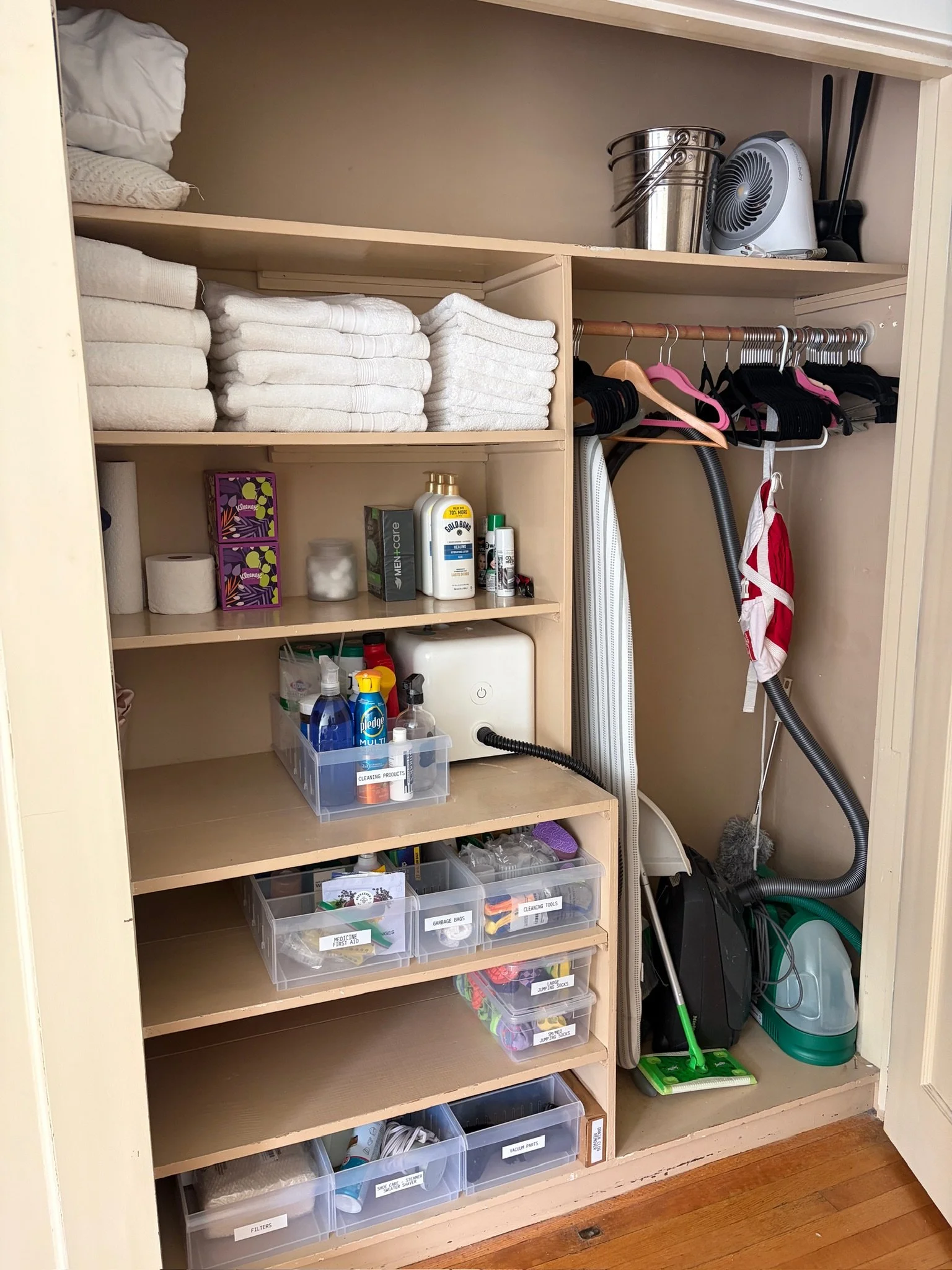
Labels are one of my favorite tools because they make a system easier for everyone to follow.
When a drawer, shelf or bin has a label, you don't have to remember where something belongs. And neither does everyone else in the house.
This is especially helpful for families.
If everyone knows that extra batteries live in the bin labeled “Batteries,” there's less guessing and less asking, “Mom, where are the batteries?”
Labels create a shared system.
They also make it much easier to put things away. You're not making a decision every time you clean up. You already know where something belongs.
You don't have to decant everything
Let's talk about one of my favorite Pinterest organizing trends: decanting.
I will admit it, beautiful matching containers filled with neatly labeled food can look amazing.
But is it practical for everyone?
Probably not.
Imagine coming home from the grocery store with a new box of cereal, crackers or pasta. Instead of putting the groceries away, you now have to open each package, find the appropriate container, empty it, and then figure out what to do with the packaging.
And what happens when you buy more than the container can hold?
Now you have an almost-empty container and an extra package that needs a home.
That's a lot of work to maintain a system that may not actually make your life easier.
If decanting works for you and you enjoy doing it, great! Keep doing it.
But if the thought of transferring every grocery item into a container makes you tired just thinking about it, you don't have to.
Sometimes keeping food in its original packaging is the most functional choice.
Pretty isn't the same thing as organized
This is something I wish more people knew.
A space can be beautiful and still be difficult to maintain.
And a space can look completely ordinary but function incredibly well.
Maybe your pantry has a mix of baskets, bins and original food packaging. Maybe your shelves aren't color coordinated. Maybe your containers don't all match.
If you can quickly find what you're looking for and easily put it away when you're finished, I'd call that organized.
Leave room for real life
Another important part of a sustainable organizing system is space to grow and change.
You don't want every drawer, shelf and bin packed completely full.
A little breathing room makes it easier to put things away and gives you somewhere to put something new without immediately creating clutter.
This is especially important in areas like pantries, closets and kids' spaces, where what you own is constantly changing.
Your home needs to accommodate your life, not the other way around.
The best systems are the ones you can maintain
When I'm organizing a client's home, I'm not trying to create a space that looks perfect on the day I leave.
I'm trying to create a system that still works weeks, months and years later.
That means considering how much time and effort a system requires.
If putting something away takes three steps, you're probably less likely to do it than if it takes one.
If the container is too full, you'll struggle to put things away.
If a label doesn't make sense to the people using the space, it won't help.
And if the system is too complicated, eventually it will break down.
Simple systems are often the most sustainable systems.
Organization should make your life easier
At the end of the day, your home is meant to be lived in.
It's where your family eats, plays, relaxes, works, celebrates, makes messes and makes memories.
It doesn't need to look perfect.
It just needs to work.
If you can find what you need, know where things belong, and easily put things away when you're finished with them, you've created something much more valuable than a Pinterest-perfect space.
You've created a home that supports your life.
And to me, that's what being organized is really all about.